

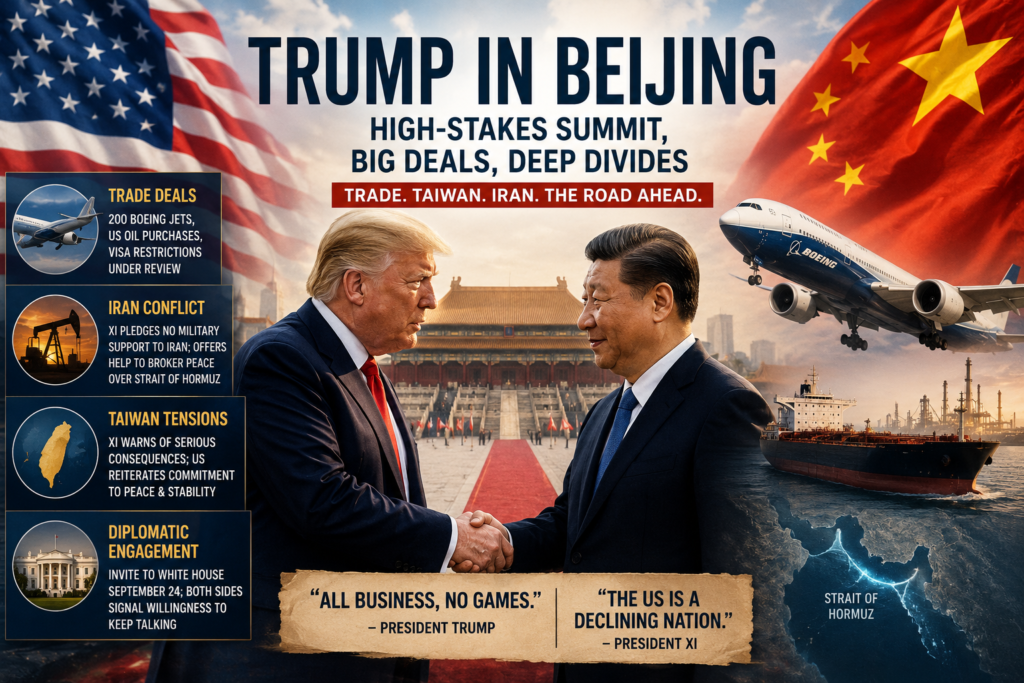
Historic Beijing Summit Signals Strategic Reset — But Deep Rivalries Remain
In one of the most consequential geopolitical meetings of 2026, Donald Trump concluded a high-stakes two-day state visit to Beijing, holding extensive talks with Chinese President Xi Jinping amid escalating global instability, mounting economic pressures, and rising military tensions across Asia and the Middle East.
The summit marked the first official visit to China by a sitting US president since Trump’s earlier presidency and represented a pivotal attempt by both powers to stabilize relations after years of deteriorating diplomacy, tariff disputes, semiconductor sanctions, military confrontations, and disagreements over Taiwan.
While both leaders publicly emphasized “constructive engagement” and “strategic cooperation,” the summit also exposed the profound structural tensions defining the modern US-China rivalry.
Key Outcomes of the Trump-Xi Summit
1. Massive Trade Agreements Announced
The most headline-grabbing development from the summit was the announcement of major economic commitments between Washington and Beijing.
According to President Trump, China has agreed to:
- Purchase approximately 200 Boeing commercial aircraft
- Expand purchases of American crude oil and energy exports
- Explore easing restrictions affecting US financial and payment services
- Reassess barriers involving international Visa-related operations in China
Boeing Deal Could Revive US Manufacturing Momentum
The aircraft agreement is expected to provide a major boost to Boeing, which has struggled in recent years with manufacturing delays, global competition, and geopolitical disruptions.
Industry analysts estimate the agreement could be worth tens of billions of dollars over the next decade, potentially supporting:
- US aerospace manufacturing jobs
- Supply chain recovery
- Export growth
- Aviation financing markets
The announcement immediately energized financial markets, particularly aviation and industrial sectors, with investors viewing the agreement as a signal that both nations are seeking selective economic stabilization despite broader strategic competition.
US-China Trade Relations Enter a Pragmatic Phase
Economic Interdependence Still Too Large to Ignore
Despite years of decoupling rhetoric, both economies remain deeply intertwined.
Major Areas of Ongoing Economic Friction
| Issue | United States Position | China Position |
|---|---|---|
| Semiconductor exports | Maintain restrictions on advanced chips | Opposes “technology containment” |
| Rare-earth minerals | Reduce dependence on Chinese supply | Use leverage strategically |
| Tariffs | Pressure China on trade imbalance | Wants rollback of punitive tariffs |
| Manufacturing | Bring supply chains back to US | Retain industrial dominance |
| AI technology | Restrict military-linked Chinese access | Accelerate domestic AI independence |
Economists note that both nations now appear to be transitioning from “full decoupling” toward a model of strategic competition with controlled economic cooperation.
Iran Conflict Emerges as Central Diplomatic Issue
China Signals Possible Role in Middle East Mediation
A major portion of the summit reportedly focused on the escalating US-Iran conflict and fears of wider regional war.
Trump stated that Xi Jinping pledged:
- China would not provide military equipment to Iran
- Beijing could assist in diplomatic mediation
- China supports reopening and stabilizing the Strait of Hormuz
The Strait of Hormuz remains one of the world’s most strategically vital maritime chokepoints, carrying a significant share of global oil shipments.
Trump Issues Stark Warning to Iran
In one of the summit’s strongest statements, Trump warned that Iran must reach an agreement or face what he described as “annihilation.”
The remarks immediately triggered reactions from international observers concerned about:
- Potential military escalation
- Oil market instability
- Global inflationary pressures
- Shipping disruptions in the Persian Gulf
China’s involvement is particularly significant because Beijing remains one of Iran’s most important economic and energy partners.
Analysts believe China’s willingness to publicly distance itself from direct military support for Iran may reflect Beijing’s broader objective of preventing a global economic shock that could threaten Chinese growth and energy security.
Taiwan Becomes the Summit’s Most Sensitive Flashpoint
Xi Jinping Delivers Strong Warning on Taiwan
Despite diplomatic progress in trade and Middle East discussions, Taiwan remained the summit’s most dangerous geopolitical issue.
According to officials familiar with private discussions, Xi Jinping warned Trump that mishandling the Taiwan issue could lead to “serious conflict.”
The warning reflects China’s increasingly uncompromising stance regarding:
- Taiwanese sovereignty
- US military presence in Asia
- Arms sales to Taiwan
- Indo-Pacific security alliances
China continues to regard Taiwan as part of its sovereign territory, while the United States maintains strategic ambiguity and continues security cooperation with the self-governed island.
Rising Military Pressure in the Indo-Pacific
Strategic Competition Intensifies
Military analysts believe Taiwan remains the single greatest long-term risk for direct confrontation between the United States and China.
Key Strategic Trends
- Increased Chinese naval activity near Taiwan
- Expanded US military coordination with Japan and allies
- Semiconductor supply chain security concerns
- Intensifying AI and cyber warfare competition
- Growing arms modernization programs
The summit did not produce any formal Taiwan agreement, but officials described the private discussions as “intense” and “highly consequential.”
Trump Invites Xi to Washington
White House Visit Proposed for September
Trump announced that he has invited Xi Jinping to visit the White House on September 24, signaling efforts to maintain diplomatic channels despite escalating rivalry.
Trump described Xi as:
“All business, no games.”
Meanwhile, Xi congratulated Trump on recent political and diplomatic successes while reportedly referencing the United States as a “declining nation” during comparisons with previous American administrations.
The exchange highlighted the unusual dynamic between the two leaders — combining strategic distrust with personal diplomatic engagement.
Rare-Earth Exports and Technology Controls Still Unresolved
Core Strategic Disputes Remain
Despite positive announcements, several major disputes remain unresolved.
Outstanding Tensions Include:
- US export controls on advanced semiconductors
- Chinese restrictions on rare-earth mineral exports
- AI competition
- Cybersecurity accusations
- South China Sea military activity
- Currency and trade imbalance disputes
Rare-earth minerals remain particularly critical because China dominates global processing capacity for materials essential to:
- Electric vehicles
- Defense systems
- Semiconductors
- Renewable energy infrastructure
Washington continues pushing for supply-chain diversification through domestic mining initiatives and partnerships with allied nations.
Political Stakes for Both Leaders
Trump Seeks Economic Wins Ahead of Midterms
The Beijing visit comes at a politically sensitive moment for the Trump administration ahead of crucial US midterm elections.
The White House is seeking:
- Lower inflation pressures
- Stronger manufacturing performance
- Export growth
- Stable fuel prices
- Financial market confidence
A successful China deal could strengthen Trump’s argument that his administration can secure better economic outcomes while maintaining a hardline geopolitical stance.
Xi Faces Slowing Chinese Growth
Meanwhile, Xi Jinping faces mounting domestic economic pressures, including:
- Slowing property markets
- Youth unemployment concerns
- Weak consumer confidence
- Foreign investment declines
- Export challenges
For Beijing, stabilizing ties with Washington may help reduce uncertainty damaging investor sentiment and industrial growth.
Global Implications of the Summit
A Temporary Stabilization — Not a Strategic Resolution
Geopolitical experts caution that the summit does not represent a true reconciliation between the world’s two largest powers.
Instead, it reflects a more pragmatic recognition that uncontrolled escalation would threaten:
- Global financial markets
- Energy security
- Semiconductor supply chains
- International trade
- Military stability
The summit may reduce immediate tensions, but the broader strategic rivalry between the United States and China is expected to define global politics for decades.
Key Takeaways
What the Summit Achieved
✔ Major Boeing aircraft purchase agreement
✔ Expanded US energy export commitments
✔ Diplomatic coordination on Iran crisis
✔ Reopening of high-level US-China communication
✔ Proposed future White House summit
What Remains Unresolved
✖ Taiwan sovereignty tensions
✖ Semiconductor export restrictions
✖ Rare-earth mineral disputes
✖ Military rivalry in Indo-Pacific
✖ Long-term economic decoupling concerns
Conclusion
The 2026 Beijing summit between Donald Trump and Xi Jinping may ultimately be remembered as a critical attempt to prevent the US-China relationship from sliding into uncontrolled confrontation.
While both leaders emerged claiming diplomatic progress, the meeting also underscored the reality that economic cooperation now exists alongside intensifying geopolitical competition.
Trade agreements and diplomatic gestures may provide temporary stability, but the deeper struggle over technology, military power, Taiwan, and global influence remains far from resolved.
As the world watches future negotiations unfold, the central question is no longer whether the United States and China are rivals — but whether their rivalry can be managed without triggering economic fracture or military conflict.
